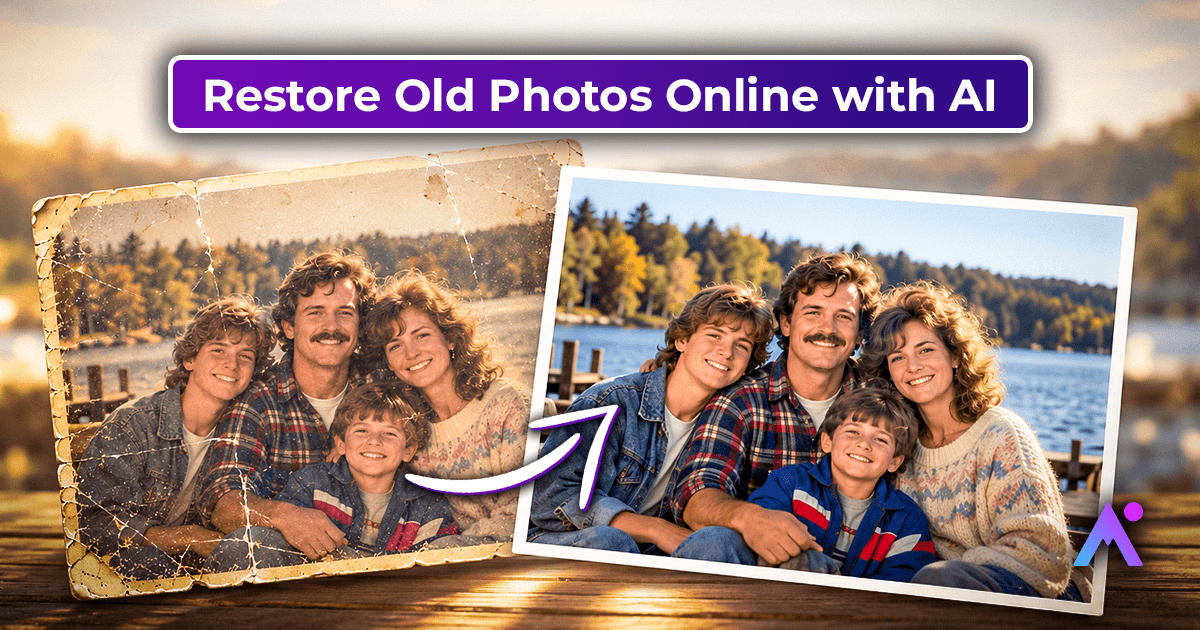
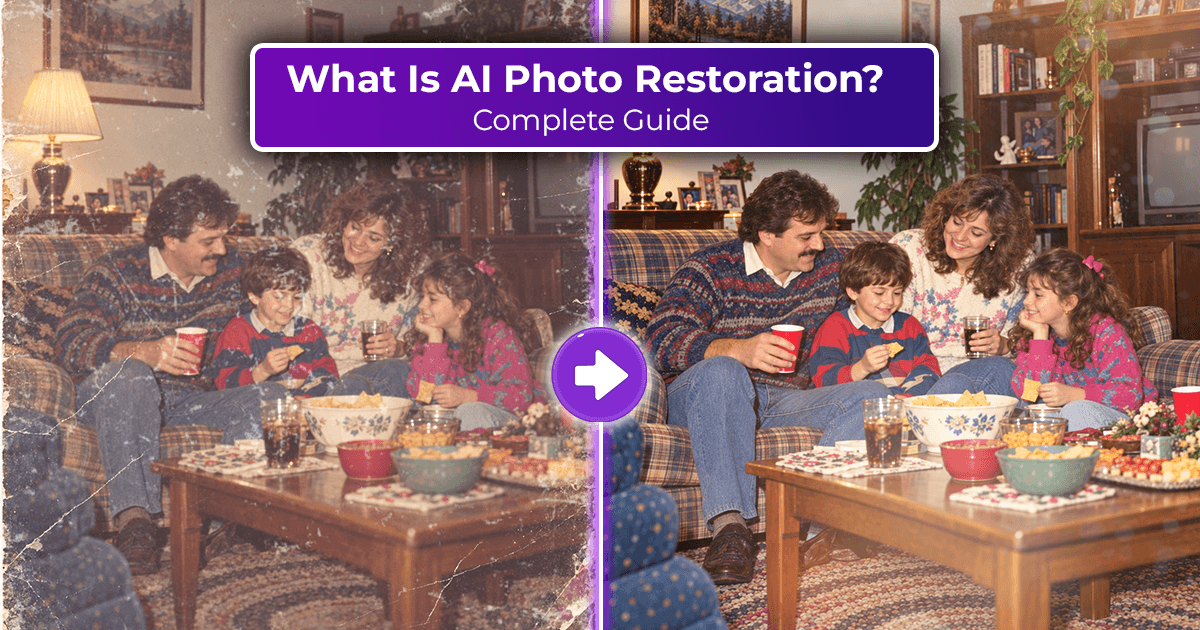
What Is AI Photo Restoration? Complete Guide
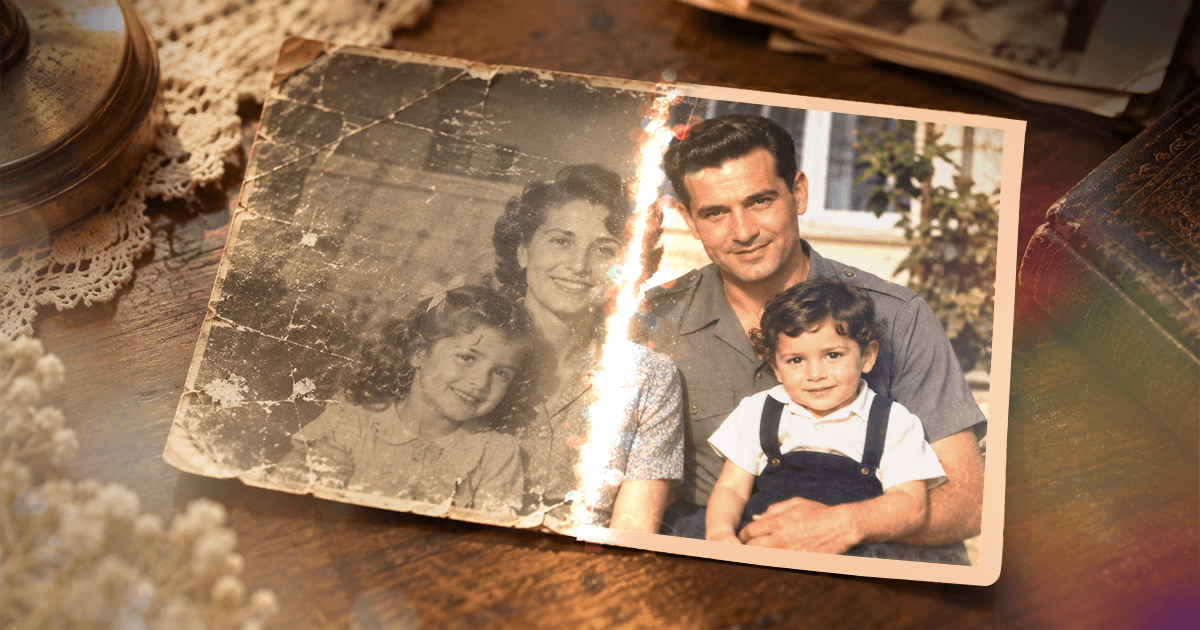
Old photographs capture some of life’s most important moments. But life itself can weather any printing. Thankfully, AI photo restoration is a hopeful path to restore precious memories. Photo restoring AI's apply artificial intelligence to learn and enhance problematic pictures and yield stunning results.
What Is AI Photo Restoration?
AI photo restoration is the use of artificial intelligence to restore and improve damaged or poor-quality photos.
In contrast to conventional photo restoring practices, AI photo restoration tools are capable of inspecting and modifying a photograph within seconds. Additionally, photo fixing AI's utilize elements of cutting-edge image-processing and machine-learning technology to recognize faces, objects, and colors. Thus, an AI can evaluate which part of a digital image needs enhancement according to its own data from facial features to stain removal.
Old photographs with scratches and faded ink can be used to find the image of a loved one. With the help of a photo enhancing AI, critical details can be resurrected.
How Does AI Photo Restoration Work?
Typically, the photo enhancing process consists of several editing stages.
An AI restoring tool analyzes inputted images to recognize and identify the details that need restoring. Photo improving AI's can detect scratches, stains, missing elements, and low resolution. Then, an AI can begin the process of rebuilding and restoring the photograph.
Essentially, the AI restoring tool will bring out the color, improve the clarity, and remove unnecessary abrasions or blemishes. In some cases, photo enhancing AI's can even magnify low-resolution pixels to enlarge the image’s width.
Depending on the inputted photo, AI photo restoration can be time-consuming and tedious. However, the outputted picture will have enhanced qualities compared to the initial imagery.
Furthermore, image modification tools equipped with AI can magnify and clarify minuscule photograph elements such as letters and facial features. Most modern tools also have an option for brightness adjusting to guarantee desired outcomes.
Finally, after all aspects of photographic content have been addressed, an AI can perform conventional photo altering conventions like contrast and saturation. As a result, the modified photograph now has improved resolution, enriched visuals, and overall organized composition.
Benefits of AI Photo Restoration
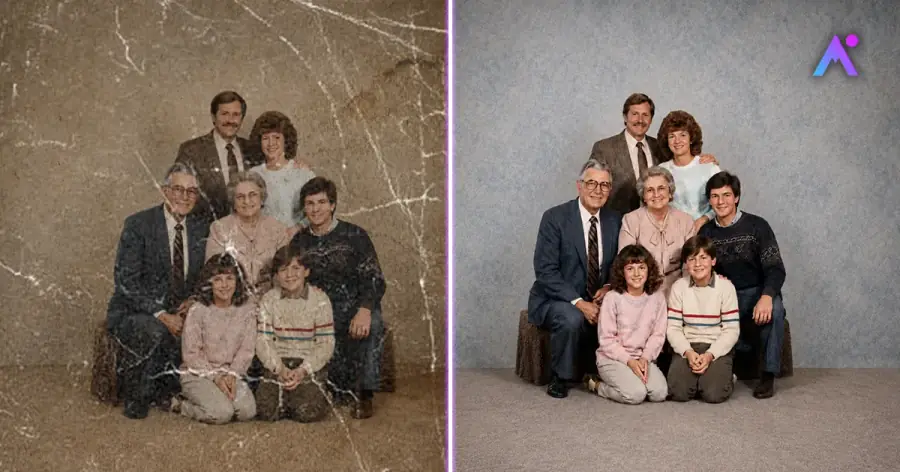
Speed is one of the main advantages of AI photo restoration. Traditional restoration is often hours of manual editing, especially if an image has many scratches or damaged areas. Many of these corrections AI tools can automatically make. automatically by AI tools.
Another benefit is availability. You don’t need to know how to edit pictures professionally to restore an old picture with an AI-powered tool. Most platforms have easy upload and restore procedures that enable beginners to enhance their images.
AI restoration can also enhance the following aspects of an image:
- Improve contrast and restore faded colors
- Remove light stains, dust, and scratches
- Enhance soft or blurry details
- Improve overall image clarity and sharpness
- Enhance low-resolution photographs
- Restore and enhance facial features
- Balance overall brightness and image quality
Why Restore Old Photos With AI?
Photos represent more than artistic collections of objects or people. Photographs symbolize cherished moments or personalities in a memorable period in our lives.
Therefore, AI photo restoration is a valuable process that can save treasured memories. Digitizing and restoring the content of your photos is an easy and affordable way to preserve those sentimental photos as heirlooms from degradation.
For example, businesses engaged in commercial ventures or professional photography can utilize AI photo restoration as a resource to revamp hundreds of photographs in short notice rather than hand-altering each image to meet necessary standards.
Thus, AI photo enhancement is more beneficial for commercial applications like digitizing film reels or home-video archives.
AI Photo Restoration Vs. Traditional Photo Restoration
Conventionally, photo restoration generally requires intensive editing with professional tools such as using digital image editing programs to fix up to 10-15% damaged sections in an hourly basis.
Photo retouching procedures typically utilize clone stamping, brush work, color correcting, sharpening, and more. However, professional grade photo enhancing usually demands thorough editing which implies long working hours that can be utterly straining.
AI photo restoration tools, on the other hand, streamline the entire process.
Instead of painstakingly fixing each area of a photograph, most AI procedures can automate most procedures. While professionals typically alter each minuscule detail, AI tools perform entire image editing automatically. As a result, businesses will not only need fewer employees for restoring photographs but also save money in the long term.
However, there is one significant disadvantage of AI photo enhancing procedures; AI's can create elements that did not exist in an image. Although such alterations can result in astonishing outcomes, professionals have higher standards for quality when addressing the restoration of valuable or artistic images. Hence, having an artistic photo and manipulating every element by hand and with the help of an AI tool would be a perfect combination to achieve the visual expectations.
Final Thoughts
AI photo enhancement represents an exciting innovation on auto-pilot. At the junction of modern image processing and artificial intelligence, AI-powered tools can be utilized to improve, alter, and increase the resolution of aged and delicate photographs.